My Early Psychomotor Signs and Perceptual and Affective Symptoms of Slipping Into Psychosis
These are differences that *I think* are there | ~1675 Words

{Disclaimer: It’s only after first-episode psychosis has ended for me that I’ve even considered what I might have been experiencing was psychosis, and have looked up screening tests online. I find screening tests composed of questions that are so vague that I would probably be hesitant to say “yes” to many of them even during times of psychosis, even if I had been referred to any during first-episode psychosis.}
I.
Because early detection is preferred, I wrote down some of my personal perceptual, affective, cognitive, and psychomotor symptoms that I’m slipping into psychosis:
Strongly increased sense of urgency → increased goal-driven behaviour that is based on internal desires (not necessarily believed to lead to external rewards)
Increased frequency of racing thoughts
Generally lowered inhibition during social interactions, similar to when influenced by alcohol
Increased frequency of thoughts that “jump” across different settings (thoughts featuring different times, different locations across the globe, and especially different people who don’t know that the other people in the thoughts close in time with each other exist)
Increased frequency of beliefs that result in anger
Increased frequency of thoughts on matters that involve specific people who may be present in my life
Increased emotional intensity of experiences (if my experiences are usually 5/10 of intensity, they become felt as 6/10-10/10 intensity)
Increased mistrustfulness within my surroundings, even if it’s hard to pinpoint what the mistrustfulness is about; increased vigilance i.e., increased worry that something might harm me and/or those I value in my life
Increased frequency of ASMR-like experiences, and increased perceived contrast between colours: “more saturated” colours in a “dimmer” environment”; “brighter” light colours including whites, and “darker” dark colours; “louder” clicks of light switches in a “quieter” setting
Increased frequency of seeing something, and relating it as a symbol or metaphor for something else
Here are some signs that I’m sometimes able to notice about myself when I’m slipping into psychosis:
Occasional increased frequency of abbreviation usage, grammatical errors, and stylistic idiosyncrasy when writing — including when typing online to others — due to feeling increased need to get thoughts out quickly
Increased frequency of going outside when it’s cold (for reasons that don’t net external rewards), and feeling less physiologically bothered by the cold
Increased frequency of simple motor tics
Increased time spent on obsessions
Increased time spent on compulsions
Increased distractibility, decreased sustained attention; increased activity on certain websites, such as Pinterest and Twitter; decreased activities on other websites, such as Tumblr and forums
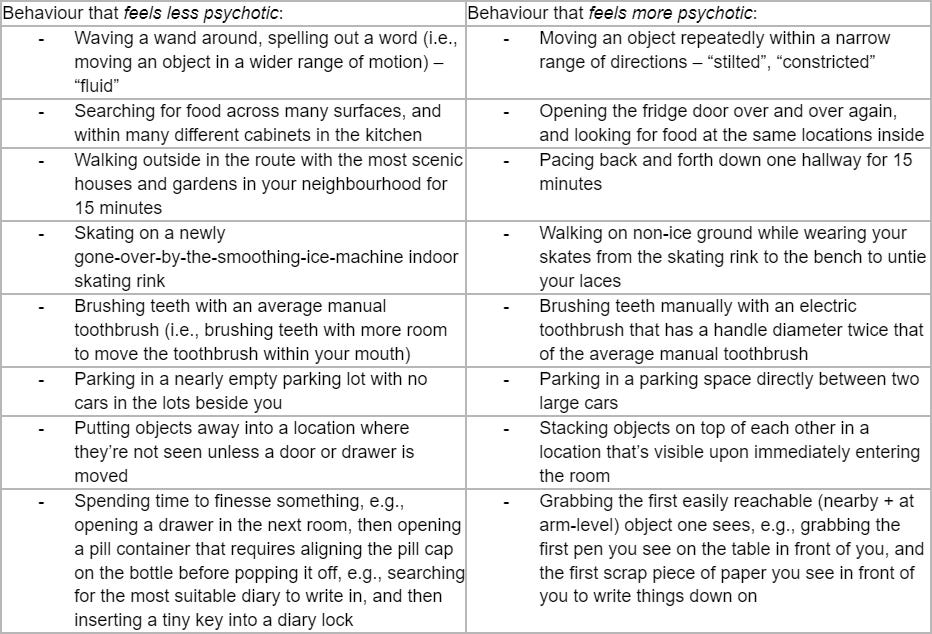
Increased frequency of grabbing the first thing I see, e.g., a pencil, instead of spending more time and using fine motor skills to access something hidden from my field-of-view, e.g., the pen that I normally write notes with
Loss of functional fixedness when moving or using objects (i.e., the innovative placement of various objects in space)
Increased frequency of restricted movements, sometimes leading to the precarious placement of objects, and/or creation of surroundings inconvenient for future usage of the items or one’s previous goals, in absence of environmental constraints (e.g., stacking objects in which the physical retrieval order from top-to-bottom is inconvenient for future usage)
II.
Here are some descriptions for movements that I personally think feel less indicative of psychosis to me vs. feels more indicative of psychosis of me — i.e., psychomotor signs visible to the person experiencing them, that others can potentially notice as well:
A personal anecdote: I don’t think “abnormal posture” is useful to include when asking sufferers to screen themselves for first-episode psychosis — I think it would increase the chance of false negatives — personally, it was too vague for me to have initially related to it. When I first heard “abnormal posture” brought up by my psychiatrist, I thought of many possibilities. I thought of examples of “abnormal posture” such as “waving hands frantically back and forth in the air”, and “crawling on the floor when you’re physically able to walk”, and “playing leap-frog inside the first-floor of a house”. So I thought, “Nope, abnormal posture? Not me, I haven’t been experiencing that recently.”
It’s also hard for me to recognize as a sign because a) I don’t see the entirety of my posture like an outside observer in space would and am sometimes not aware when it’s taking place, b) if I’m in one posture for a long time, that usually means my attention is fixated somewhere else (e.g., arranging objects or writing) so that I’m not consciously having thoughts about my body positioning, and c) I do not feel confidently aware of what the “normal” postures other people tend to find themselves in are. And then, with d) It doesn’t feel any type of way to me! It doesn’t feel like tiring posture, exhausting posture, straining posture, it feels physically comfortable to me at the time — and therefore is not even felt as a symptom.
(I’m not usually going about my day thinking, “Someone observing my body positioning from one (or various) angles would observe that I’m positioned abnormally relative to objects in space relative to ways of positioning seen in the general population”.)

I prefer the term “restricted movements” because what I usually see is the movements of my hands and forearms performing actions.
(One could be performing a contemporary dance, and exhibiting “abnormal postures” frequently throughout it; but this ought not to be classified as a symptom of psychosis. But hey, on the other hand, performing a contemporary dance generally does not involve restricted/”stiff”-looking movement.)
Now that I’ve read that it’s a sign of psychosis, I’m more attentive to when my posturing is abnormal.
III.
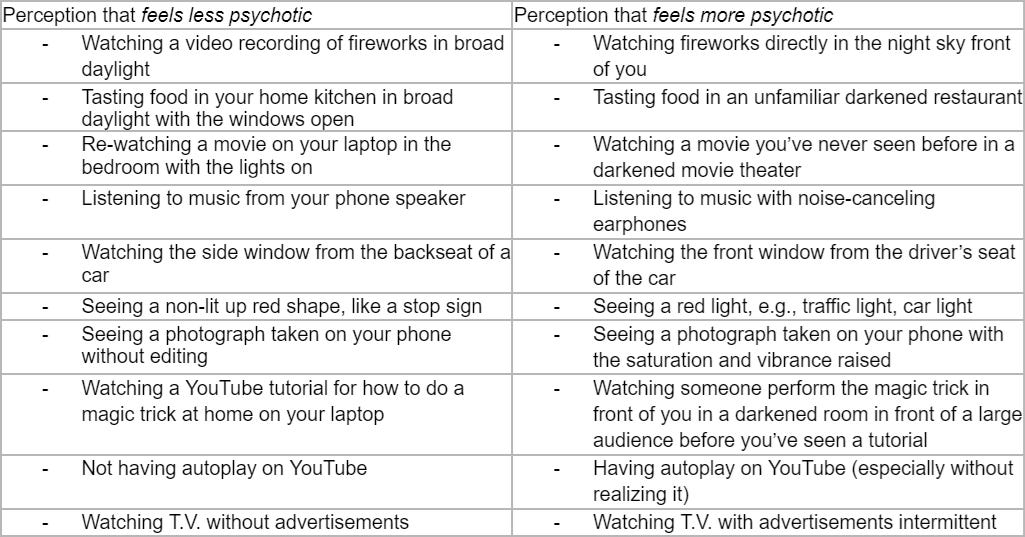
During my first episode of psychosis, I didn’t experience any hallucinations — only delusions. Nonetheless, the episode did include differences from my usual sensory experiences. These are analogies suggesting what the having of perceptual symptoms feels like to me, in case this would help one recognize them in oneself:

IV.
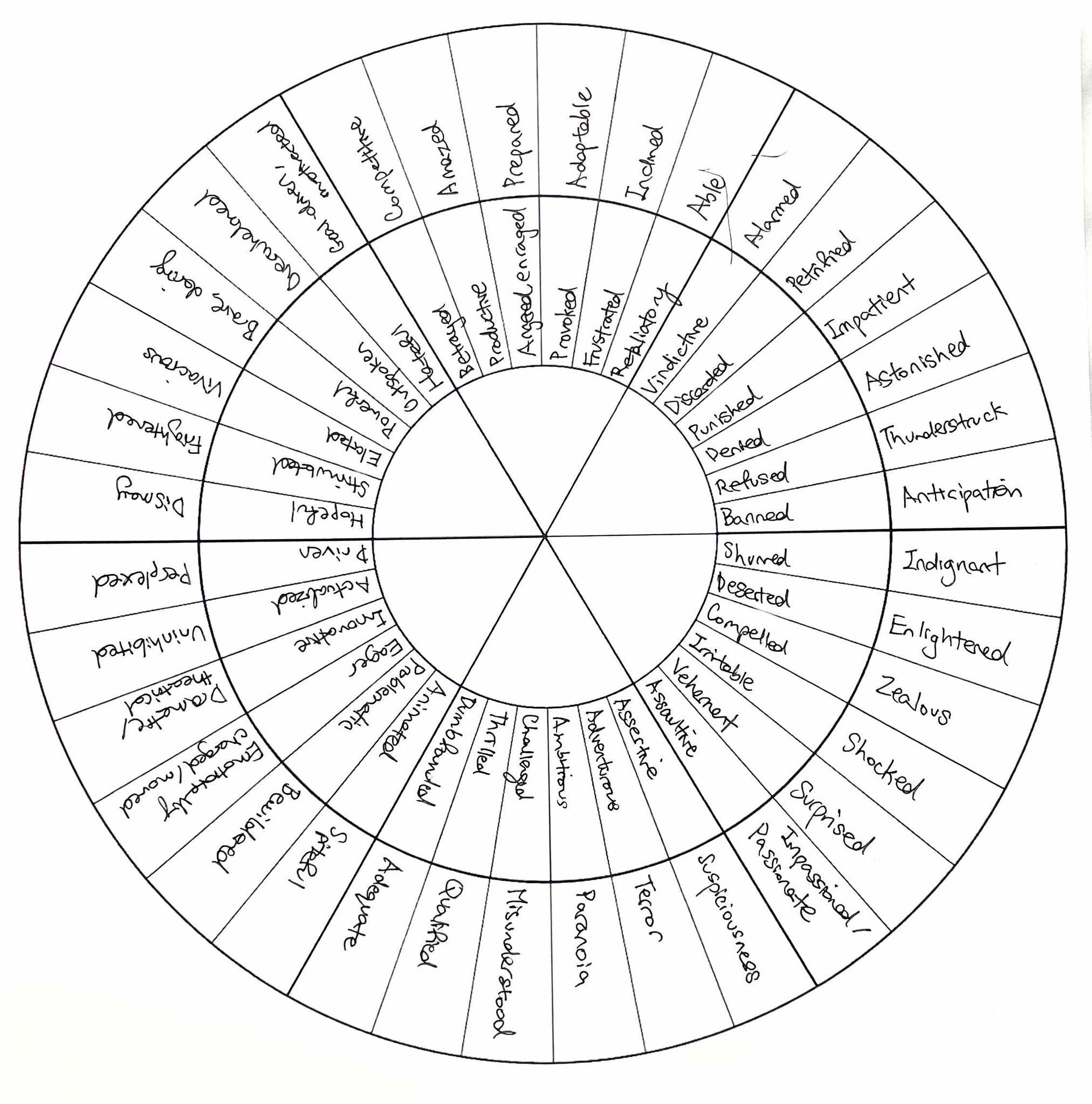
Accompanied by delusions were many feelings and adjectives that described them, that I felt more frequently during first-episode psychosis than any previous time in my life. Some feelings were the result of actions that I did in first-episode psychosis that were witnessed by others (i.e., I might not do those same actions now with awareness about my disorder), and did not arise concurrent with delusions. This part is just for FEP — I had increased frequencies of these feelings (often as a part of having delusions, hypomania, or after actions and reactions from others to my actions fueled by delusions and/or during hypomania):