Defining Hallucinations And Illusions And So Forth
Hallucinations are a giant bucket category | ~2123 Words

{Disclaimer: Am I even qualified to write about this? Probably not. Are you qualified to disagree with me? I definitely think so, if you’re someone who hallucinates on your brain’s own accord, and are willing to describe the experience. I also think so if you’re knowledgeable about neuroscience. I’ve only ever had one visual hallucination, and it was hypnopompic. I’ve only pseudohallucinated on three different locations and/or days; it was the smell of cannabis. These were in April or May 2024. I’ve been on 40mg Latuda since mid-April 2024 and I experience visual illusions almost every day.}
I.
I’m going to argue about definitions first because I think understanding between those who hallucinate as a result of psychotic disorders and those who do not can be improved if we do.
I’m a layperson — not a neuroscientist — and I make the assumption that a hallucination’s occurrence maps onto activity in the brain. And this differentiates instances when someone with a psychotic disorder hallucinates vs. when they’re not hallucinating.
I assume that there’s biology (notably but not exclusively involving the brain) that differentiates the average person who hallucinates without medication to the average person who doesn’t, even when the hallucination-prone person isn’t actively hallucinating.
Wikipedia mentions:
“A hallucination is a perception in the absence of an external stimulus that has the compelling sense of reality. [07/08/24]
A textbook I have, Physical Examination and Health Assessment: Fourth Edition (Jarvis et al., 2023) mentions:
“Hallucinations (perceptions occurring while the patient is awake and conscious and in the absence of external stimuli).”
And I think it’s alright, but not ideal; it only tells part of the story.
I agree that there are no… molecules of spider if you’re hallucinating a spider m, but I think this provides an insufficient definition.
As far as I know, it has not been determined whether hallucinations are a combination of [non-self only stimuli, eg “the lighting is dim, so the hallucination, like everything else in the field-of-view, is dim”{ +/ [the memory of previous non-self only stimuli, eg “couches are frequently sat on by humans, and the couch is there, so the hallucination is of a human sitting on the couch; and not of a dinosaur or neanderthal sitting on a couch”], or exclusively of stimuli only relating to the self at the very moment.
Only saying “seeing something that isn’t there (another way I’ve seen the focus on lack of external stimuli worded) can be conflated with “There is nothing different from the norm — eg thoughts-wise, emotion-wise, sensory-wise — occurring in the person in that occasion”, which I think is not true; I assume that brain and/or body activities map onto cognitive, affective, and sensory experiences.
That there is an “absence of external stimuli” can easily be conflated with “There is nothing different from the norm in the external environment in this hallucinatory scenario compared to a counterfactual non-hallucinatory scenario”, which I AFAIK is not something that we can justify enough as being true enough to include in a definition.
…until someone else lets me know differently, I consider a hallucination:
A perception that results from particular stimuli relating to the self that isn’t considered vision impairment; if someone else with the ability to sense is in the vicinity, they would struggle to observe it, if at all; if a sound (eg voice), one may not see what one expects to in the location it's observed as from
Stimuli relating to the self that cause hallucinations is a broad category that includes changes to the self from recreational drugs, trauma, sleep deprivation, starvation, retina diseases, genetics, and other factors; this isn’t a comprehensive list.
Macular degeneration, eye floaters, cataracts, lack of depth perception, night blindness would not be considered hallucinatory, but vision impairing, being different in that they distort sights less temporarily than hallucinations. It can be arguable whether something should be considered vision impairment or a hallucination.
I’ve come across the word pseudohallucination, which I don’t think is necessary for laypeople to know, since it’s easy to explain (eg in the case of a visual hallucination), “Something I knew was only seen by me” or “Something I saw, but knew was subjective”.
Wikipedia mentions:
“A pseudohallucination is an involuntary sensory experience vivid enough to be regarded as a hallucination, but which is recognised by the person experiencing it as being subjective and unreal.”) 07/08/24
…which is fine.
Back to differentiating phenomena with commonness as a dimension: Having some mental imagery is normal, although I personally couldn’t object to mental imagery being included under hallucination since it can include hyperphantasia (I’m unable to have input on how similar hallucinations and hyperphantasia are), with dreams being a type of mental imagery.
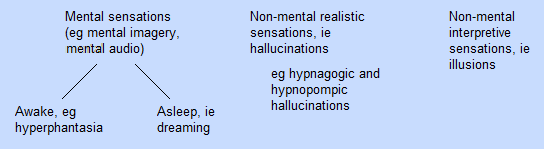
II.
One theme in the story of schizophrenia is one of not shunning a diversity of interpretations of sensory experiences.
There are myriad examples where the perceiver does not well-understand the nature of the phenomena that is happening, and as a result, may attribute the phenomena to something other than what is happening. For example, I can perceive a mirage — what seems to be pools of water on a road some days while being driven in a car. I know that has something to do with physics, but I don’t understand any more of physics than what was taught in Grade 10 in high school.
(I can also see what can be metaphorized in layman language as something “looking like a bent piece of metal (e.g., spoon)”, and is an un-bent piece of metal in water, with little knowledge of refraction.)
And then, there are cases in which things are interpreted as having a different external stimuli than the external stimuli that causes it, ie cases of being mistaken about the source of the stimuli.
These can include feeling a bug crawling on your arm outdoors in summer, and looking to see it’s a leaf from a plant brushing your skin; feeling an itch on your arm and thinking there’s no bug on it, and looking to see there is a mosquito currently on the area that is itching; putting your hand into a backpack thinking you’ve fished out a pencil, only to see once you lift your hand out of the backpack that it’s a pen. And so forth.
And then, there are cases when you’re not just mistaken, but cases where you experience illusions, which AFAIK are brief misinterpretations of existing stimuli.
Non-schizophrenics can experience illusions, such as optical illusions. Even if there remained only one human alive, if it would possible for them be fairly certain they’d experienced illusions.
I didn’t know illusions were more common among schizophrenics until I read about schizophrenics describing their experiences on Tumblr:
"I'd love it if more people understood the difference between hallucinations and illusions. So let me try to explain with examples. [TW: examples of auditory hallucinations and illusions described as you experiencing them]

1. Imagine you are home alone with your windows closed and it's silent. And then you hear unfamiliar voices talking about you, it sounds like they are coming from another room. You go to check but no one is there. Your brain created entire voices of people out of thin air. This is a hallucination. There is nothing but your brain creates something.

2. Now imagine you are in the same scenario but your windows are open but the curtains are closed. You hear your neighbors having a conversation, and you hear it as them talking about what you are doing in that moment. They couldn't possibly see what you are doing, so realistically they can't be talking about you, but your brain makes you change the words and hear it that way. This is an illusion. There is something but your brain changes the real thing into something unreal.

It's not always easy to know the difference when you are experiencing it. But if you do know which one it is (nothing there and something unreal appears or something there changes to something unreal) then I think it can be really helpful to label the symptom accurately.

For me it was helpful to gage the effectiveness of my medication. I noticed that I have more illusions than hallucinations, and for me that was a sign of improvement. It can also go the other way, to see if your psychosis is getting more severe."

Source: @schizopositivity
"So the same rule still applies: hallucinations are your senses creating something that isn't there, and illusions are your senses altering something that is already there.

If you are at your house and home alone with no pets, and you see a panda bear crawling around, that's a hallucination. Nothing is moving like that in your house but your brain created the visual of a panda.

If you are at your house and home alone but you have a large dog, and you see your dog walking around but with the head of a panda, that's an illusion. Your dog is moving around, but your brain changes the visual of the dog's head into the head of a panda.

I'll do another example. But I will be describing bugs and food, read under the cut if you want to, or don't press "read more" if you don't want to read about bugs and food.

Imagine you are about to eat a stir fry with rice, you made it, and you know your kitchen is clean. But when you go to eat it suddenly you see a tarantula on top of the food. It doesn't make sense because you don't even have tarantulas in your area, and there aren't bugs in your house. After a minute the spider just disappears, not crawling away but just vanishing. That was a hallucination, there were no bugs or moving things on top of you food, but your brain created the image of a tarantula. The hallucination was sitting on top of a real item (your food) but was an entirely new thing that your brain created.

Now imagine you are about to eat a stir fry with rice, you made it, you know you used rice, and that your kitchen is clean. But when you go to eat the food, suddenly each grain of rice on your plate looks like a little worm. After a minute the worms stop moving and go back to looking like regular grains of rice. That was an illusion. The grains of rice were there, but your brain changed what they look like and made them look like little worms.

I'm sorry for the gross descriptions but the illusion example is actually one of my most frequent visual illusions that I get (I hate it). Both hallucinations and illusions can be very disturbing and impact your life. It isn't always easy to tell them apart, but it also isn't super important to identify them correctly unless you want to track your personal progress or worsening symptoms."

Source: @schizopositivity
III.
Here are examples — some which are colloquially called hallucinations, and some not — where abnormal self-stimuli is present, resulting in perceptions most people would not see had they been transported to that location at that time, that can also be perceived by the individuals with those perceptions alongside varying degrees of knowledge about what they are:
Charles Bonnet syndrome — seeing phenomena only in presence of self-stimuli when you have experienced significant vision loss; it may not be immediately understood as being associated with blindness.
Eye floaters, which I started noticing having at age 26.
I would estimate, without having recorded anything, once every week, if they’re in the corner of my eye, for a millisecond I interpret eye floaters as moving shadows. Was a cat or person moving in the corner of my eye? I might briefly wonder. I don’t know if this happens more often for me than non-schizophrenics with eye floaters; I could just be more prone to reporting it.
My point is, there are phenomena that people without idiopathic psychoses experience that are similar to symptoms of idiopathic psychosis, and that idiopathic psychoses may not be as different from people’s usual states as the layperson believes it to be, although the symptoms in schizophrenia are also associated with other symptoms.
A more general theme of my personal journey is that not only should we embrace diversity in the sensory experiences among people, we must not avoid the unknown if we wish to learn more about others. That is how we find out what differences exist between ourselves and others, right?
We must explore the unknown — in any way if it is believed to be safe, or safely, if it is believed to be unsafe.