Convenient Benevolence: Responding To Delusions
The good Samaritan response to my past delusions would've included trying to get me to seek medical attention | ~2557 Words

{11/21/24 Edit — I’ve found this post, which links to a study that found that “personalized evidence-based dialogues” with AI (GPT-4 Turbo) “reduced conspiracy belief by ~20%”. This, along with my own experiences of having delusions, leads me to think that clinically delusional beliefs are more malleable than people typically believe.}

I.
Someone biking crashes into the ground on the gravel beside you, and doesn’t move for a few seconds – do you say nothing to them, or do you ask, “Are you okay? Do you need any help?”
Let’s say you don’t ever believe in being a good Samaritan. Or you do, but only for some people, and this group excludes those who experience delusions during episodes of psychosis caused by schizophrenia.
If that’s the case, this post is not for you.
But if you do believe in being a good Samaritan at least from time to time…
Then, that’s a good thing for people on the psychotic spectrum! Because you could be someone who witnesses us experiencing a psychotic episode – and if there are obvious signs in your presence, then you can suggest what we are exhibiting are symptoms of psychosis, and strongly recommend that we seek treatment.
So, first, you’d have to know the signs of psychosis. Signs manifest differently in each sufferer of psychosis — I write about some of my personal signs here.
First of all, and I mention this because it is by far the most popular method I have been met with upon sending direct messages on Discord and Facebook, and sending emails that shared delusions in first-episode psychosis: The Silence Treatment is not the way to go if you witness someone believe a delusion caused by idiopathic psychosis.
(It may even contribute to the person who exhibits the delusion/s relinquishing their friendship with you.)
Second, insults are also not the way to go. I state this because I have been met with them. Blocking is also not the method to be a good Samaritan, which I remember happened to me four times in FEP (with all but one instance being felt as shocking to me), and which never in my memory have I noticed happening to me by online acquaintances nor IRL friends before and since.
II.
In Canada, children are given strong recommendations in elementary school for how to reduce harm from fires: crawl as close to the floor as possible, feel the surface of doors for temperature before opening them, and test fire alarms in home now and then, as fires are emergency situations.
Yet we aren’t ever taught harm reduction for “Interacting with someone who is having psychotic delusions” — a state that can be psychologically, emotionally, and/or physically dangerous for the sufferer of delusions, as well as people living with them, and less often other people in their physical proximity.
Less important than recommendations for being around fires, and still worth educating at least at subsection of the population on (worth it for whom? Well, for sufferers of idiopathic psychoses and those affected by them!), would be guidelines of conduct for interacting with people manifesting delusions.
I read these Guidelines for responding to a person experiencing delusions, and I don’t agree with everything written there, but I do like some suggestions:
"Let the person know that you recognise the feelings that can be evoked by the delusions. For example, you could say: ‘It must feel very frightening to think that there is a conspiracy against you.’ Respond to the underlying feelings and encourage discussion of these rather than the content of the delusion."
Their emotions might be where their attention is focused at the moment — they could be overwhelmed with paranoia or suspicion, with feelings of betrayal, rage, fear, hatred. Asking them how they feel gives them a good opportunity to vent their feelings, and it also shows that you value their emotional wellbeing.
It might also provide them with more information to look back later on, if they ask themselves, “How will I know something is a delusion?” which can be a hard question to answer for the sufferer. They may connect some dots: “That time when I felt super betrayed/enraged/fearful/hateful was a time I had a delusion.”
"Validate any part of the delusion that is real. For example, depending on the situation, you could say: ‘Yes, there was a doctor at the nurse’s desk, but I did not hear him talking about you.’"
Some people say that reality-orientation is not a good strategy to signal benevolence to the psychotic person, but personally, I would wish for someone to distinguish what is true and as what isn’t true about my delusional beliefs.
I’m *pretty sure* this doesn’t apply to everyone who has delusions, but personally I would also want someone to signal strong disagreement if they do strongly disagree with any of my beliefs. That’s because my delusions may be strongly held beliefs, so it may take facing another person with strong conviction against my beliefs to make me rethink them. “I read what you wrote, and based on observations I’ve made in my life, I’m ALMOST CERTAIN XYZ is NOT the case / From what I’ve observed, I STRONGLY DISAGREE with your beliefs about XYZ” are some ways to signal strong disagreement.
This is not because I believe I’m likely to be convinced immediately (it’s possible for me to “think loopholes” through my delusions), but because if I later (whether sometime later during the episode of psychosis or after being medicated for it) recognize I was having a delusion, I can look back and think, “Hey, this person was right back then when they said my belief wasn’t true. And my concerns mattered enough for them to signal their dissent.”
"In your initial assessment, ask the person to talk about the delusions and obtain details by asking the following questions: ‘Who is trying to hurt you? Could you think why? How might this happen?’"
Further investigating the delusion even if you do not believe what the sufferer believes shows that you value what this person — even during a psychotic episode — believes (which not everyone might), and that you’re willing to spend time on something that matters only to them, and probably not to anyone else in the world, which again, not everyone might.
I would guess that people are more often disturbed and mentally “scarred” by the events believed-to-be happening and actually happening in their life when they’re in psychosis than when they’re outside of it. People in psychosis may be convinced of very distressing pasts, presents, and futures. They may feel paranoia, betrayal, and rage as a result of their delusions. They may repeatedly face heavy ostracization, including being blocked, insulted, and ignored by people around them who do not accept their differing, unverifiable beliefs.
All this to say is… that I was met with very little kindness when I shared delusions with friends, family, and strangers during my first episode of psychosis.
One person stands out: he was a stranger who was exceptionally attentive, and read as well as responded in detail to direct messages I sent, despite these messages being certainly difficult as well as not-the-most-pleasant to to read — with disorganized syntax, abhorrent content, unverifiable information, frequent topic-jumping, concerns being solely focused on ones that affected me, and a shocking amount of grammatical errors.
(I’m too ashamed of the delusion to share a screenshot of these particular direct messages I sent, or else I would share some here. And it sounds cheesy, but his replies were felt by me as caring and compassionate.)
All this to say… is that in my experience, any kindness you show someone experiencing delusions will shine as a beacon of light among a plethora of painful social experiences, and will probably be remembered as anomalous, and probably will not be felt like a diminishing return.
III.
When you are talking to a very unwell person, the good Samaritan thing is to try to get them to seek medical attention.
Here’s a my ChatGPT version of a default reply:
“Hey there, I find your behaviour very concerning. I know it might seem unlikely, as you may have learned very little about it in compulsory schooling, but I think there’s a possibility you’re in the altered mental state called psychosis. I think the beliefs you’re experiencing are caused by psychosis, and you wouldn’t have them without psychosis. That’s what your beliefs XYZ — that I certainly don’t think are true [again, some sources recommend against this; personally, I would strongly prefer people to signal disagreement] — resemble to me. Being in psychosis can have devastating consequences, so it’s really important that anyone who could be in psychosis seeks out treatment as promptly as they can. That “anyone” includes you, as well as anyone else out there possibly experiencing psychosis. Many people have inadequate information about what psychosis is, so even if you think it’s impossible that you’re experiencing it now, it could be that your understanding of it is different from what I’m referring to, and what doctors refer to as psychosis. I strongly believe it’s important that you see a doctor ASAP about the possibility of being in a state of psychosis — I really want to emphasize this part. I strongly believe getting an assessment is very important for you on the road to happiness, and that booking an assessment is definitely worth the hassle.”
And a follow-up a few days later, could be:
“I’m wondering if you’ve seen a doctor about the potential of being in a state of psychosis yet? I stand by my belief that my concern was valid, that psychosis is a strong possibility, and that you should get assessed for it immediately.”
Even if they don’t get assessed for psychosis immediately, you’ve done an good deed.
Being in psychosis and currently experiencing delusions does not contraindicate the discovery of true beliefs – eg you can look up the weather network app, and read that it’s -20 degrees Celsius in your city, and believe in it with it being true. And I’m certain that hypothetically someone could believe they’re in psychosis, and ought to see a heath care provider, while they’re in psychosis.
IV.
Some delusions might feel like personal attacks, and it’s okay to stop interacting with someone if they exhibit these delusions: you have every right if they interfere with your own wellbeing. I just think before you do, it’s the bare minimum to let this other person know that a) they could be having delusions, that b) they could be experiencing the onset of the psychiatric disorder known as schizophrenia, and c) they should see their doctor immediately.
If someone falls off a bike, it’s the bare minimum in what I think of as ‘benevolence where it’s convenient’ to ask if they’re alright.
And if a friend is describing what sounds like symptoms of Covid-19, the bare minimum in benevolence where it’s convenient is stating that you think they might have Covid-19.
I realize if the average person hears a maskless stranger coughing on the bus, and thinks, “That person could have Covid-19”, the average person wouldn’t go up to this stranger to them and recommend, “Have you been tested for Covid-19? If not, it would still be a good idea to wear a mask.”
But if it’s your friend who says they feel fatigued, have been coughing for days, and have had a fever for the past two days, would you pretend you didn’t notice if you recognized these are signs and symptoms of Covid-19? Or would you mention, “That sounds like you might have Covid-19?”
(And if you wouldn’t for friends, would you for your own child?)
Let’s say your significant other has Covid-19. You don’t have symptoms yet — and don’t think you’ve caught it — so you avoid sharing the same bowls and cutlery as them. You avoid kissing your SO. Covid-19 is temporary, and most people know that – so it’s only for a short while that your behaviour around your SO changes.
With my onset of my delusions in 2021 that I began exhibiting around others — which included paranoid and persecutory delusions — some of formerly self-believed friends ended up avoiding me for months longer than my belief in my delusions lasted, and most seem to be avoiding me indefinitely.
In a way, exhibiting psychotic behaviours — especially delusions IME — around others is a test or filter, whether anyone wanted one in the first place or not, for whether people ought to keep each other in their lives — and that’s a discernment that goes both ways.
V.
I want to complain about something I saw on Reddit on 07/04/24; it was one of the top comments, with 539 likes:
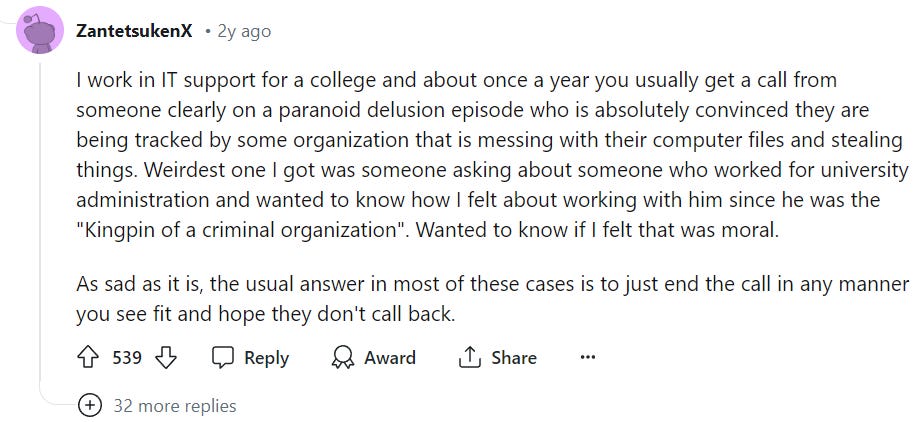
Also inappropriate, like the silence treatment or blocking, would be hanging up in a phone conversation — IMO even if it’s with a stranger.
The question I have for him (and those who agree with him) is:
Does he believe what he’s doing improves life for humanity more than continuing to talk to the person having delusions?
I mean, there’s a slim chance of the writer of this post getting physically hurt if someone is in psychosis around him, and there’s the opportunity cost if someone he usually trusts for advice to make decisions is in psychosis, or someone he usually relies on for emotional support is preoccupied with psychotic delusions.
If he believes the situation is sad (also connotating that he sees people experiencing delusions as objects of pity), isn’t his “answer” making reality even sadder or worse, relative to continuing to listen to the person, and/or signaling disagreement, for people experiencing psychotic episodes, as well as people in general?
What is the basis for his recommendation? Why does he believe this ought to be the “answer”? I view his “answer”, as suboptimal, and not well-informed.
VI.
PPS: I think if you’re kicking people out of a server, you (or someone else in the server) ought to let them know why they’re being kicked, especially if it’s from a smaller server. Because I’ve been kicked out of 2 smaller Discord groups (of… ~50-200 members; I don’t recall exactly) without a warning, and without a single PM from the person who did the kicking, or anyone else in the server. I had to spend a lot of time to find out that the kick had been because of messages I had sent that were suspicions of mine, and only found out because one person in that server was still willing to keep in contact with me. My motive had been to protect vulnerable people in the server, but I had mistakenly thought one person (who ended up being the only person that helped me in my investigation) was nebulously suspicious.
PPPS: If you notice someone has been kicked out of a server, and you consider them a friend, I would directly message them or at least reply to them if they message you about their kick. It could matter a lot to them. However, if you would discard someone partially or fully because one person with permissions in the Discord server kicks them, you’re not alone, because 2-3 people who I’d thought of as friends who wouldn’t do that, did exactly that for me. (Meanwhile, 2 were not like that.) And when I listen to this song, I think of what happened (although literally, unlike what the lyrics may suggest, I believe we all lost out), but I won’t be thinking about anyone in particular. Perhaps I didn’t matter enough to some of those people who abandoned me in the first place – whether that says more about them, or me, or neither, I can’t say for sure.